
 Deutsch
 English
Products description
Der Nachkriegsbär by Hermann-Coburg
Merkmale:
- Unikate, Archivmuster und Einzelstücke in der Teddy-Fabrik besondere Kostbarkeiten und Raritäten
Der Nachkriegsbär - ein kostbares Dokument der Zeitgeschichte
W 4124
Wertvolles Original Archiv-Muster
Raritätenfund aus dem HERMANN-Archiv der Nachkriegszeit aus den späten 1940er und frühen 1950er JahreMade in Germany
Name: Der Nachkriegsbär - ein kostbares Dokument der Zeitgeschichte
The "Post-War Bear" - a precious Document of Contempory History
Raritätenfund aus dem HERMANN Archiv
Besonderheit: Genau dieser Bär aus den 1950er Jahren ist in CIESLIKs Preisführer von 1996 aufgeführt und wurde seinerzeit (1996) von den Autoren Edith und Johan Koskinen mit einem Wert (1996) von DM 700 bis 800 eingestuft
Limitierungsnummer: nicht limitiert
Herstellungszeitraum: Original Archivmuster aus der Nachkriegszeit der späten 1940er bzw. frühen 1950er Jahre
Besonderheit Edition: Never-Come-Back
E-shop Nummer: W 4124
Modellart: Bär mit eingesetzter Schnauze
Modell: 5-fach gegliedert auf Scheiben gearbeitet mit drehbaren Armen, Beinen und Kopf,
Modell-Kennzeichen: mit der Nähmaschine eingenähte Ohren und als typisches Modell-Merkmal für einen Teddybär seiner Zeit: mit sehr kurzen Armen mit sehr kleinen Fußsohlen mit sehr tief angehängten Beinen
Größe: 42 cm = 16 ½ inches
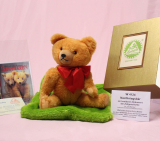
Fell: orangefarbener, matter Acryl-Wirkplüsch aus den späten 1940er bzw. frühen 1950er Jahren
Fell Schnauze: kurzfloriger, beige farbener Kunstseiden-Webplüsch
Sohlen und Pfoten: fleischfarbener Filz
Füllung: mit Holzwollfüllung und teilweise mit Styroporfüllung
Stimme: mit Brummstimme
Nase: aus schwarzem Filz aufgeklebt
Mund: handgestickt
Augen: mit eingezogenen braunen Glasaugen
Schmuck: mit einer Halsschleife aus 5 cm breitem roten Taftseiden-Band
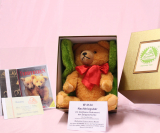
Schaukarton: der Bär sitzt in einem wertvollen goldfarbenen Präsentationskarton
Beigabe: Teil-Kopie aus dem CIESLIKs Preisführer von 1996 von Edith und Johan Koskinen
Kopie des ersten HERMANN Nachkriegs-Katalog von 1947 der Firma Max Hermann & Sohn, Sonneberg
Teil-Kopie des HERMANN Katalogs von 1952 der Fa. Max Hermann & Sohn, Sonneberg
Teil-Kopie des HERMANN Katalogs von 1952 der Fa. HERMANN & Co. Coburg
(Anmerkung: Die beiden 1952 erschienen Kataloge unter dem Namen Max Hermann & Sohn Sonneberg und unter dem Namen für die bereits 1949 in Coburg etablierte Firma Hermann & Co. sind völlig identisch und unterscheiden sich lediglich in der Firmenangabe auf der ersten Innenseite. Dies war auch der letzte HERMANN Katalog, der auch unter der Firmenbezeichnung Max Hermann herausgegeben wurde. Unter dem Eindruck der politischen Verhältnisse verließ die Familie Max Hermann im Februar 1953 ihre Heimatstadt Sonneberg für immer, um in Coburg die Tradition der Herstellung guter Teddybären fortzuführen. Man ließ alles zurück, brachte aber mit einen guten und bekannten Namen, der von Sonneberg aus in alle Welt getragen worden war und das Wissen um die Herstellung guter Teddybären.)
- size: 42 cm / inch
- Edition: Archiv piece

The Post-War Bear
a precious Document of Contemporary History and a Witness to its Time
The war and post-war era, extending into the 1950s, was characterized by material shortages. Mohair plush, which in the 1920s and 1930s had come primarily from England, could no longer be purchased at all. For the production of Teddy Bears, these materials were available only insofar as old residual stocks still remained in the warehouses of renowned, traditional manufacturers. The Teddy Bears of those years were crafted primarily from rayon plush, or increasingly from acrylic knitted plush, a material newly developed by German weaving mills in the late 1940s and early 1950s as a more affordable alternative to woven rayon plush.
The Teddy Bear design itself also underwent a transformation in appearance during the 1940s and 1950s compared to the "Golden Twenties" of the interwar period. To conserve materials during the post-war era, the arms of the Teddy Bears were made shorter, as the length of the arms had no bearing on the Bear's overall size classification. The foot pads were also reduced in size. This too allowed for savings on plush during production without altering the Bear's designated size. Above all, however, the Bear's legs were attached very low on the body. This strategic placement allowed the Bear to be classified as larger in terms of its overall length. Thus, a Bear that was originally 30 cm or 35 cm tall could now be marketed as a 40 cm Bear.
To make the production of Teddy Bears more cost-effective, labor time was also reduced. The ultimate goal was to ensure that everyone and not at least the many refugees of the era could afford a Teddy Bear during the economically challenging post-war years. Thus, the embroidered nose was in some cases replaced by the simple application of a felt oval. The embroidery of claws was also frequently dispensed with. Regarding the head, the central gusset was omitted in certain models. This allowed for the elimination of an entire seam. Furthermore, this pattern design made it possible to attach the ears using a sewing machine, whereas on the original models of the 1920s and 1930s, the ears still had to be sewn on by hand, a very time-consuming process.
It was not until the era of economic recovery and growing prosperity in the 1960s that the good old Mohair-Bear made a full return to the stage as a staple plush toy; concurrently, the design of the Teddy Bear itself became more elaborate once again. Thus, perhaps more than any other product, the Teddy Bear stands as a valuable witness and a true reflection of the era into which it was born. As an irreplaceable treasure and a precious historical artifact, the original Post-War Bear, with all its specific quirks, tells us above all the story of a time when people once again found joy in the little things. In this way, a Teddy Bear, no matter how simply designed, could gladden hearts, even while the times themselves remained difficult and challenging. The traditional manufacturers of plush Teddy Bears rose to the occasion, creating models that perfectly captured the spirit of that era. And today, original Teddy Bears from those years are traded on the secondary market at high prices, cherished as valuable and irreplaceable witnesses to their time.
Der Bär mit eingesetzter Schnauze
Modell-Erklärungen
Beim "Bär mit eingesetzter Schnauze" handelt es sich um eine Modellart, die von Max Hermann in den 1920er Jahren entwickelt wurde. Bei diesem Modell besteht die Schnauze aus einem kürzerflorigen Plüsch als der Bär selbst. Sie wird gesondert zugeschnitten und an das Kopfteil des Bären angenäht. Mit dieser Modellvariante wurden die Teddybären von Max Hermann bekannt und berühmt. Wie kaum ein anderes Bärendesign ist der "Bär mit der eingesetzten Schnauze" mit dem Namen HERMANN verknüpft und hat Geschichte geschrieben. Noch heute ist diese Gestaltungsart das bevorzugte Teddybären-Modell in unserem Hause.
The Classic HERMANN Bear with inserted snout
Design Explanation
The "Bear with inserted snout" is a type of model developed by Max Hermann in the 1920s. For this model, the snout consists of a shorter-pile plush than the bear itself. It is cut separately and sewn onto the bear's head part. With this model variant, Max Hermann's Teddy Bears became known and famous. Like hardly any other bear design, the "Bear with the inserted snout" is linked to the name HERMANN and has written history. Still today this design is the preferred Teddy Bear model in our company.

HERMANN-Spielwaren, now located in Coburg-Cortendorf / Germany, is one of the oldest still existing Teddybear companies worldwide. Founded 1920 in Neufang near Sonneberg / Thuringia the history goes back to the year 1913, when Max Hermann manufactrued his first Teddybear together with his brother Arthur and his sister Adelheid.
The company is famous for there extraordinary designs, there craftmanship, there exclusive small editions and that each bear, made in Coburg / Germany is a own personality. Each bear is made by highskilled longtime employees, many of them work over 10 years for HERMANN-Spielwaren.
Each wellknown teddybear book features the designs and also the Teddybear magacines are in close contact the the company for new styles. Des Chef-Designer is Ulla Hermann, granddaughter of the founder. Her Teddybears won famous Awards, like the TOBY Industry’s and Public’s Choice Award, the Golden Teddy Award or the TED worldwide Award.
Valuable collector’s item. This product is not a toy in the sence of the toy guideline (2009/48/EC Attachment I, 2 c + d). This product is intended only for adult collectors with an age of 14 years and over.

This Product was added to our catalogue on 29/05/2026.