
 Deutsch
 English
Products description
HERMANN Zwiebelmuster Bär #02 by Hermann-Coburg
Merkmale:
Unikate, Archivmuster und Einzelstücke in der Teddy-Fabrik besondereKostbarkeiten und Raritäten
HERMANN Zwiebelmuster Bär
Art.Nr. 12001-6
Wertvolles Original Archiv-Muster Nr. 002 aus dem HERMANN-Archiv von 2001
Made in Germany
Name: HERMANN Zwiebelmuster-Bär
Wertvolles Original Archivmuster aus dem Jahr 2001
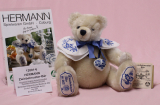
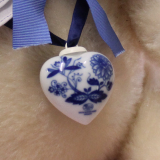
Besonderheit: mit einem Original Hutschenreuther Porzellan Zwiebelmuster-Herz
Limitierungsnummer: Nr. 002 aus dem HERMANN Archiv von 2001
Limitierungsauflage: 1000 Stück - weltweit
Herstellungsjahr: Dezember 2000
Besonderheit Edition: die Edition ist ausverkauft - Never-Come-Back
Kollektionsnummer: 12001-6
Kennzeichen: jeder Bär ist einzeln nummeriert. Die individuelleLimitierungsnummer ist auf der rechten Fußsohle des Bären eingestickt.
Modellart: Bär mit eingesetzter Schnauze
Modell-Besonderheit: der Körper des Bären ist in Form einer "Zwiebel"rund gestaltet
Modell: 5-fach gegliedert mit drehbaren Armen, Beinen und Kopf, mitHERMANN-Halsmarke, HERMANN-Einnähetikett undHERMANN-Anhängeplombe, mit Echtheitszertifikat
Größe: 39 cm = 15 ¼ inches
Fell: weißer Mohairplüsch
Schnauze: kurzfloriger, weißer Schnauzen-Mohair
Sohlen und Pfoten: weißer Leinenstoff
Füllung: handgestopft mit Holzwolle
Augen: mit blauen Sicherheitsaugen
Schnauze: handgestickt
Stickerei: beiden Sohlen sind wertvoll bestickt mit dem ZwiebelmusterMotiv.
Die rechte Sohle ist zusätzlich mit dem Namen des Bären und derindividuellen Limitierungsnummer 002 bestickt.Kleidung: Der Bär trägt einen großen Leinen-Kragen, der sehraufwendig und wertvoll bestickt ist mit dem Zwiebelmuster-Motiv.
Besonderheit Schmuck: Der Bär trägt umden Hals ein Original echtes Hutschenreuther Zwiebelmuster Herz, das vonder Porzellan-Manufaktur Hutschenreuther exklusiv für den HERMANNZwiebelmuster-Bären entwickelt wurde, und nur in Verbindung mit demHERMANN Zwiebelmuster-Bär erhältlich ist.
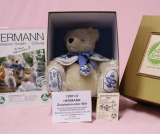
Schaukarton: der Bär sitzt in einem wertvollen, goldfarbenenPräsentationskarton
Beigabe: HERMANN Katalog von 2001 in deutscher Sprache
HERMANN Katalog von 2001 in englischer Sprache
- size: 39 cm / 12 inch
- Edition: #002

Der HERMANN Zwiebelmuster-Bär
The HERMANN "Blue Onion Pattern" Bear
The "Onion Pattern" - "Zwiebelmuster" - is the oldest and most renowned Germanporcelain decoration applied using underglaze painting. The earliest examplesof the Onion Pattern can be found on Meissen porcelain dating back to around1728. The pattern is characterized as a plant-based ornament, resemblingan onion, that was modeled after the East Asian pomegranate motif. Itimpressively reflects the significant influence that Asian decorative elementsexerted on German porcelain painting during that era. The color "Blue", producedusing a secret formula derived from cobalt ores, was in 1717 the very firstcolor that could be applied as an underglaze on porcelain - in contrast thecolourful overglaze colors - this method ensured exceptional durability.For a long time, the color "Blue" remained the only such color available.It was not until 100 years later that the color "Green" was successfullydeveloped as the second underglaze color.
The so-called "blue painting" marked the beginning of the triumph of everydaytableware in Europe. The Onion Pattern quickly and enduringly displaced otherblue motifs, as it could be adapted to every conceivable vessel shape. Itdemonstrates an astonishing, impressive and unique longevity and enjoysunparalleled popularity and sympathy until today.
The Onion Pattern motif was adopted by many German porcelain manufacturers.The most famous Onion Pattern in high-quality porcelain today is the BlueOnion Pattern porcelain from the Hutschenreuther porcelain manufactory, foundedin 1814. Many pieces from the Hutschenreuther Blue Onion Pattern have becomehighly sought-after collector's items.
Exclusively for the HERMANN Onion Pattern Bear, Hutschenreuther created theOnion Pattern Porcelain Heart that the HERMANN Onion Pattern Bear wears aroundits neck. This Onion Pattern Heart is available only in conjunction withthe HERMANN Onion Pattern Bear and underscores the unique nature of thisextraordinary Collector's Bear.
Mit Holzwolle gestopfte Teddybären ein wahrer Raritätenschatz
Mit Holzwolle gestopfte Teddybären gehören zum Raritätenschatzder Teddybärenwelt und werden heute kaum noch auf dem Markt angeboten.Was früher zum täglichen Handwerk der Teddybärenmachergehörte, ist zu einer wertvollen und raren Kostbarkeit geworden. Weltweitgibt es nur noch eine Handvoll Experten, die heute noch die traditionelleKunst des Holzwollstopfens beherrschen. Eine jahrelange Ausbildung, Muskelkraftund ein künstlerisches Gespür für Formgebung sind erforderlich,um den sehr zeitaufwendigen Arbeitsgang des Holzwollstopfens auszuführen.Nur sehr alte und traditionsreiche Manufakturen haben heute überhauptnoch das Wissen, wie Teddybären nach altem Vorbild mit Holzwolle gestopftwerden können, so dass mit Holzwolle gestopfte Teddybären heutekaum noch zu finden sind.
Seit über 100 Jahren pflegen wir in unserem Haus die Kunst des Stopfensder Teddybären mit Holzwolle. Dies macht unsere Teddybären zuunvergleichbaren und einzigartigen Geschöpfen mit werterhaltendem Charakter.
Teddy Bears stuffed with excelsior a true treasure
Teddy Bears stuffed with excelsior belong to the rarity treasure of the TeddyBear world and are only rarely offered on the collector's market today. Whatused to be the daily work of the Teddy Bear makers in former times, has becomea valuable and rare treasure today. Worldwide there are only a handful ofexperts who are still familiar with the traditonal art of excelsior stuffing.Years of training, muscle strength and an artistic sense for styling arenecessary to carry out this very time-consuming work. Only very old andlong-standing manufactures have still the knowledge today, how Teddy Bearscan be stuffed with excelsior according to old example, so that nowadaysexcelsior stuffed Teddy Bears are hardly to find.
For more than 100 years, we have cultivated the tradition of stuffing ourTeddy Bears with excelsior and we have preserved for us this knowledge untilltoday. This gives our Teddy Bears their exceptional value and makes themto uncomparable and unique creatures with value-preserving character.
Der Bär mit eingesetzter Schnauze Modell-Erklärungen
Beim "Bär mit eingesetzter Schnauze" handelt es sich um eine Modellart,die von Max Hermann in den 1920er Jahren entwickelt wurde. Bei diesem Modellbesteht die Schnauze aus einem kürzerflorigen Mohairplüsch alsder Bär selbst. Sie wird gesondert zugeschnitten und an das Kopfteildes Bären angenäht. Mit dieser Modellvariante wurden dieTeddybären von Max Hermann bekannt und berühmt. Wie kaum ein anderesBärendesign ist der "Bär mit der eingesetzten Schnauze" mit demNamen HERMANN verknüpft und hat Geschichte geschrieben. Noch heute istdiese Gestaltungsart das bevorzugte Teddybären-Modell in unserem Hause.
The Classic HERMANN Bear with inserted snout model explanation
The "Bear with inserted snout" is a type of model developed by Max Hermannin the 1920s. For this model, the snout consists of a shorter-pile plushthan the bear itself. It is cut separately and sewn onto the bear's headpart. With this model variant, Max Hermann's Teddy Bears became known andfamous. Like hardly any other bear design, the "Bear with the inserted snout"is linked to the name HERMANN and has written history. Still today this designis the preferred Teddy Bear model in our company.

HERMANN-Spielwaren, now located in Coburg-Cortendorf / Germany, is one of the oldest still existing Teddybear companies worldwide. Founded 1920 in Neufang near Sonneberg / Thuringia the history goes back to the year 1913, when Max Hermann manufactrued his first Teddybear together with his brother Arthur and his sister Adelheid.
The company is famous for there extraordinary designs, there craftmanship, there exclusive small editions and that each bear, made in Coburg / Germany is a own personality. Each bear is made by highskilled longtime employees, many of them work over 10 years for HERMANN-Spielwaren.
Each wellknown teddybear book features the designs and also the Teddybear magacines are in close contact the the company for new styles. Des Chef-Designer is Ulla Hermann, granddaughter of the founder. Her Teddybears won famous Awards, like the TOBY Industry’s and Public’s Choice Award, the Golden Teddy Award or the TED worldwide Award.
Valuable collector’s item. This product is not a toy in the sence of the toy guideline (2009/48/EC Attachment I, 2 c + d). This product is intended only for adult collectors with an age of 14 years and over.
This Product was added to our catalogue on 29/05/2026.